Hydration for training in Dubai heat: how much to drink, when, and what actually helps

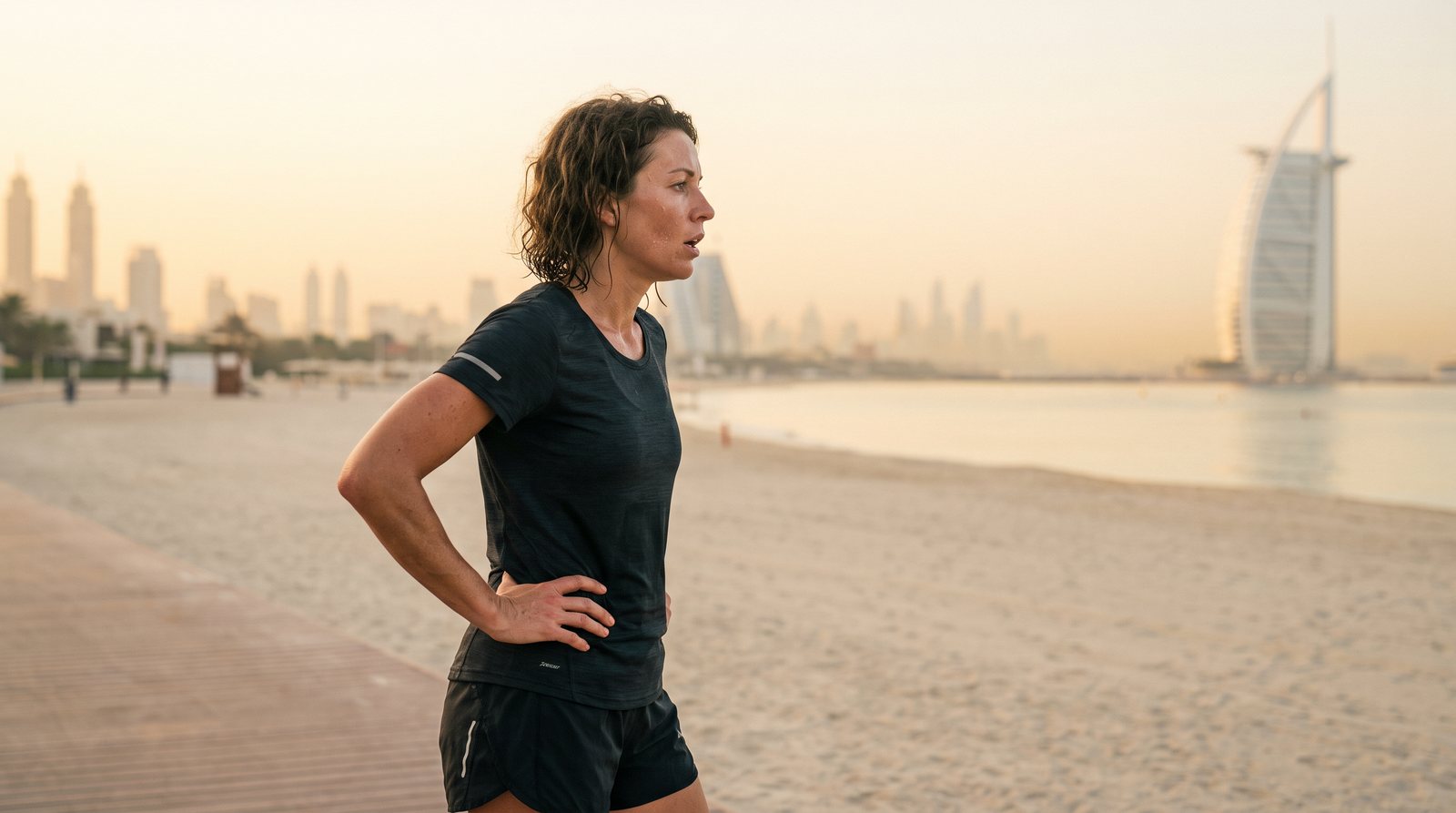
Hydration for training in Dubai heat is a different problem from hydration anywhere else. Between June and September the coast sits at 40°C or more with humidity that stops sweat from evaporating, so you lose fluid faster and cool down slower than the generic “eight glasses a day” advice assumes. This guide gives you numbers you can actually use: how much to drink per hour, how to measure your own sweat rate, why some people still feel flat after drinking plenty, and where premium waters such as deuterium-depleted water do and do not fit.
Why Dubai heat hits hydration harder than dry heat
Your body cools itself by evaporating sweat off the skin. In a dry desert that works well, which is why 40°C in the inland Emirates can feel more manageable than 36°C on the Jumeirah coast. Once humidity climbs past about 60 per cent, the air is already holding so much water vapour that sweat drips off instead of evaporating. You are losing fluid without getting the cooling benefit. Research on self-paced exercise in humid heat shows that both sweating efficiency and performance fall as humidity rises, even when the thermometer reading stays the same.
Two practical consequences follow. First, your fluid losses on a humid morning run are higher than they feel. Second, drinking more water does not fix the cooling problem on its own, which is why timing, shade and pace matter as much as the bottle in your hand.
How much should you drink when training in Dubai?
Sweat rates of around one litre per hour are common during moderate exercise in the heat, and studies of walking and jogging sessions in hot conditions have recorded averages closer to 1.3 litres per hour. Left to drink freely, most people replace only about 80 per cent of what they lose. For a Dubai summer session the working numbers are:
- Two hours before: 500 ml with a normal meal, so you start the session hydrated rather than trying to catch up.
- During: 400 to 800 ml per hour, sipped every 15 to 20 minutes rather than gulped at the end. Heavier sweaters and longer sessions sit at the top of that range.
- After: roughly 1.25 to 1.5 litres for every kilogram of body weight lost, spread over the next two to four hours.
Those are starting points. The only way to know your own number is to measure it.
How to measure your sweat rate in 10 minutes
- Weigh yourself in minimal clothing immediately before a session.
- Train for one hour. Track exactly how much you drink.
- Towel off and weigh yourself again.
- Weight lost in kilograms plus fluid drunk in litres equals your hourly sweat rate.
Someone who loses 0.8 kg while drinking 0.5 litres has a sweat rate of 1.3 litres per hour. Repeat the test once in an air-conditioned gym and once outdoors, because the two numbers will differ, and plan each type of session around its own figure.
Drinking plenty of water but still feeling tired? Check these first
This is one of the most common complaints in the Emirates over summer, and it is rarely a water-volume problem. Run through the list in order.
- Sodium. Sweat carries between roughly 500 and 1,500 mg of sodium per litre. Replace two litres of sweat with plain water and you have diluted your blood sodium while replacing none of it. Headache, flatness and cramping follow. For sessions over an hour, or any outdoor session in summer, add sodium through food or an electrolyte mix.
- Overnight losses. Air-conditioned bedrooms are dry, and you wake up already a few hundred millilitres down before the day starts.
- Caffeine and timing. Coffee is not dehydrating at normal doses, but three iced lattes and no water by noon is a fluid plan built on the wrong drink.
- Sleep and heat load. Training at 5 pm in August adds heat stress that no amount of fluid removes. Move sessions to dawn or indoors and the tiredness often resolves on its own.
The simplest daily check is urine colour: pale straw is the target, and dark yellow in the afternoon means you are behind regardless of how many bottles you think you have had.
Timing your sessions around the UAE summer
The UAE’s midday break rule stops outdoor labour between 12:30 pm and 3 pm from mid-June to mid-September for a reason. For training, the practical windows are before 7 am and after 8 pm, and even then the evening is often more humid than the morning on the coast. The Kite Beach and Jumeirah tracks, Al Qudra cycle path and the canal loops all fill up at dawn for exactly this reason. If your schedule only allows midday, take the session indoors and treat the air-conditioned sweat-rate test as your reference.
Does the type of water matter?
Here is where it is worth being honest, because the premium water shelf in Dubai is crowded. For replacing fluid lost in sweat, the volume you drink and the sodium you take with it matter far more than the brand. Desalinated tap water in the UAE meets World Health Organization standards; its main drawback is low mineral content, which is easily covered by diet.
Deuterium-depleted water is a separate proposition. It is not an electrolyte product and it does not hydrate you faster; a litre of it replaces a litre of sweat exactly as a litre of tap water does. What it changes is the isotope composition of the water you drink, reducing naturally occurring heavy hydrogen from about 150 parts per million to, in Cancro’s case, 125 ppm. The interest from athletes comes from laboratory work on how deuterium affects the enzymes involved in cellular energy production. That research is real but early, and mostly preclinical: a 2024 scoping review in Metabolomics (Korchinsky et al.) identified 15 studies and concluded that more randomised controlled trials are needed before cause and effect can be established. No published trial has measured deuterium-depleted water against ordinary water for running performance or recovery, and we are not going to pretend one has.
So the sensible framing for anyone training in the UAE is: fix volume, sodium and timing first, because those are proven. If you are then curious about deuterium-depleted water, treat it as a daily drinking water choice rather than a sports drink, and judge it on how it fits your routine over a few weeks rather than on any claim of a percentage gain.
A summer training hydration checklist
| When | What to do | Why |
|---|---|---|
| Night before | Salt your evening meal normally; 500 ml water before bed | Offsets dry air-conditioned sleep losses |
| On waking | 500 ml water; check urine colour | Start the session hydrated, not catching up |
| During (under 1 h, indoors) | 400 to 600 ml plain water | Sodium loss is modest; food covers it |
| During (over 1 h, or outdoors) | 600 to 800 ml per hour with 500 to 700 mg sodium per litre | Replaces both fluid and salt lost in heavy sweating |
| After | 1.25 to 1.5 L per kg lost, over 2 to 4 hours, with a meal | Full rehydration without overshooting |
| Monthly | Repeat the sweat-rate test | Rates change as you acclimatise, usually within 10 to 14 days |
Warning signs that mean stop
Dizziness, confusion, nausea, a headache that gets worse as you drink, or sweating that suddenly stops are signs of heat illness rather than simple dehydration. Get into the shade or air conditioning, cool the skin with water, and seek medical help if symptoms do not ease within a few minutes. No hydration strategy, and no water, replaces that.
Cancro is a beverage, not a medicine. It is not intended to diagnose, treat, cure, or prevent any disease. Research referenced on this page describes deuterium-depleted water in general and is not a claim about this product. Hydration figures are general guidance for healthy adults; people with medical conditions should follow advice from their own clinician.
Related reading
- What is deuterium-depleted water? A plain-English guide
- Deuterium ppm levels explained: what the number on the bottle actually means
- Deuterium-depleted water in the UAE: where to buy it and what it costs
- Where the deuterium in your body comes from: water, food, metabolic water, and how fast it changes
- How to read a bottled water label in the UAE: TDS, pH, sodium, magnesium, potassium and deuterium