Where the deuterium in your body comes from: water, food, metabolic water, and how fast it changes

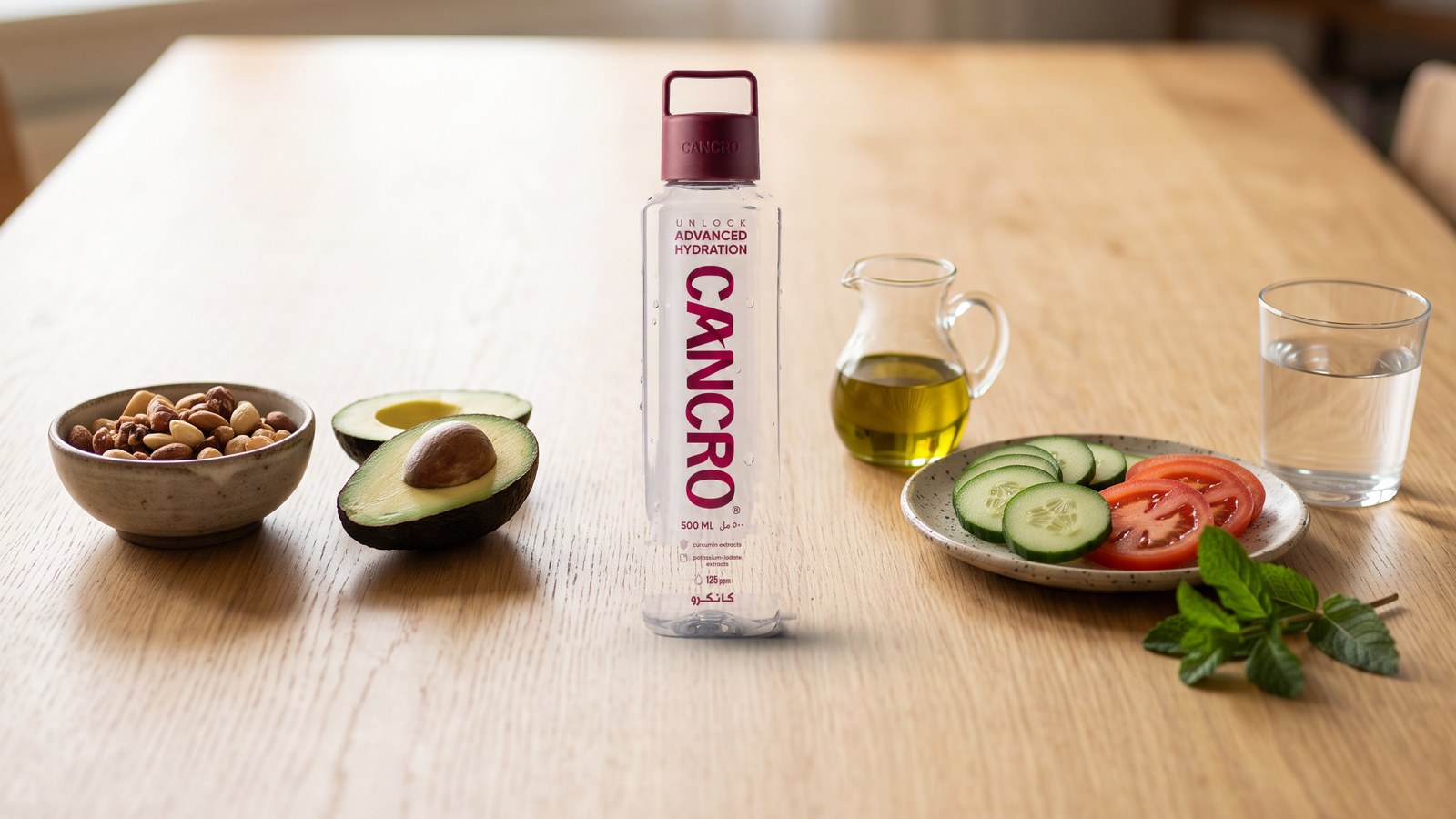
The deuterium in your body comes from three places: what you drink, the water already in your food, and “metabolic water” your body makes when it breaks down food. Lean adults are about 50 to 60% water, and that water is replaced continuously: about 8% a day in a temperate climate and more in hot ones. A change in what you drink therefore shows up within weeks, but food keeps your body from simply matching your drinking water.
Key takeaways
- Body water is where most of your deuterium sits, at roughly the level of the water you take in.
- Drinks provide most of your water; food provides around a fifth; metabolism adds a little more.
- About 8% of body water is replaced each day in temperate climates, and 50 to 100% more in tropical heat (IAEA).
- In one study, body-water half-life was 7.5 days in sedentary young men and 5.9 days in endurance runners.
- Your hair records the isotopes of your local water and diet. Switching to 125 ppm water lowers body-water deuterium gradually and partly, not all the way to 125 ppm.
Three sources: drinks, food water and metabolic water
| Source | What it is | Share of daily water (typical adult) |
|---|---|---|
| Drinks | Water, tea, coffee, juice and every other beverage | Most of it, roughly four-fifths |
| Water in food | Fruit, vegetables, soups, cooked grains, dairy | Around a fifth |
| Metabolic water | Water your cells produce when they burn fat, carbohydrate and protein | A small extra, a few hundred millilitres a day |
Each source carries its own deuterium level. Drinking water reflects where it came from: in a worldwide survey, bottled waters ranged from about 133 to 158 ppm. Food water reflects where the food was grown. Metabolic water takes its hydrogen from the food itself, which brings us to diet.
Why food matters: not all hydrogen is equal
Living things do not take up deuterium evenly. When plants and microbes build their molecules, the enzymes involved discriminate against the heavier isotope to different degrees, so fats, sugars and proteins end up with deuterium levels that differ from the water the organism grew in. Research in microbes has shown that the deuterium content of fats varies widely depending on the metabolic pathway that made them.
Some researchers have proposed that diets favouring fats over sugars and starches lower deuterium intake. That remains a hypothesis. A 2024 scoping review of nutritional deuterium depletion found only a small number of relevant studies, mostly early, and just one randomised controlled trial, and its authors called for more controlled trials. We make no diet claims; we note it because it explains why the deuterium in your body is not simply a copy of your water.
Your body keeps a record: the hair evidence
One of the clearest demonstrations comes from forensic science. Researchers analysed scalp hair from people in 65 US cities and built a model predicting its hydrogen and oxygen isotopes from local drinking water and diet. The model explained more than 85% of the variation, and hair isotopes tracked the tap water of each city. Your body reflects the water you drink, filtered through what you eat.
How fast body water turns over
Researchers measure body-water turnover by giving a small, harmless dose of heavy water and tracking how quickly it disappears in urine. The IAEA, which publishes the method, puts typical turnover at about 8% of body water a day in temperate climates and 50 to 100% higher in the tropics. In one study of young men, the half-life of that label was 7.5 days in sedentary men and 5.9 days in endurance runners, meaning 9 to 12% of their body water was replaced each day. A study of more than 5,600 people across 23 countries found that turnover rises with physical activity, air temperature and humidity.
| Time after switching drinking water | Share of the eventual change reached (half-life about 7 days) |
|---|---|
| 1 week | About half |
| 2 weeks | About three-quarters |
| 3 weeks | Close to 90% |
| 4 weeks | Over 90% |
In a UAE summer, with sweating, air-conditioned dryness and more to drink, water moves through your body faster than these temperate figures. See our guide to hydration in Dubai heat.
What switching to 125 ppm water can and cannot change
If you replace your everyday water with deuterium-depleted water at 125 ppm, your body water moves towards a new, lower level over the following weeks. It will not reach 125 ppm, because food water and metabolic water keep arriving at close to natural levels. As a rough illustration, if around three-quarters of your incoming water is 125 ppm and the rest is close to 150 ppm, body water settles in the low 130s ppm. The real figure depends on your diet, climate and how much you drink.
That is why we describe Cancro as everyday water rather than a one-off drink. Most people start with one bottle every morning. What the research does and does not show about effects is covered in is deuterium-depleted water safe? and where deuterium-depleted water sits on the evidence ladder. For the physics of the isotope, see heavy water vs deuterium-depleted water, and for production, how deuterium-depleted water is made.
What we do not know yet
- How much individual diets shift body-water deuterium in practice, measured in people rather than estimated.
- Whether modest changes in body-water deuterium have measurable effects in healthy people. Human studies so far are small and early.
- How climate, activity and fluid intake interact over months.
Frequently asked questions
Does drinking deuterium-depleted water lower the deuterium in your body?
Gradually and partly. Body water is replaced continuously, so drinking 125 ppm water moves body-water deuterium lower over a few weeks, but food and metabolic water keep it above 125 ppm.
How long does it take for body water to change?
About 8% of body water is replaced daily in temperate climates, and more in hot ones. In one study, body-water half-life was about 7.5 days in sedentary young men and about 6 days in endurance runners, so most of a change happens within three to four weeks.
Do foods contain deuterium?
Yes. All food contains hydrogen, and part of it is deuterium. Levels vary with where the food was grown and what kind of molecule it is, because plants and microbes take up deuterium unevenly when they build fats, sugars and proteins.
What is metabolic water?
Water your body produces when it breaks down fat, carbohydrate and protein for energy. It adds a few hundred millilitres a day and takes its hydrogen from your food.
Can you measure the deuterium in your body?
Yes, in a laboratory: deuterium in urine, saliva or blood samples can be measured with isotope analysis. It is a research and clinical measurement rather than a routine consumer test.
Is there a deuterium-depleted diet?
Some researchers have proposed eating patterns that favour fats over sugars to lower deuterium intake. The human evidence is still small and early, and a 2024 scoping review called for more controlled trials.
Sources
- International Atomic Energy Agency. Introduction to body composition assessment using the deuterium dilution technique. IAEA Human Health Series No. 12, 2010.
- Shimamoto H, Komiya S. Comparison of body water turnover in endurance runners and age-matched sedentary men. Journal of Physiological Anthropology and Applied Human Science, 2003.
- Yamada Y, Zhang X, Henderson MET, et al. Variation in human water turnover associated with environmental and lifestyle factors. Science, 2022.
- Ehleringer JR, Bowen GJ, Chesson LA, et al. Hydrogen and oxygen isotope ratios in human hair are related to geography. PNAS, 2008.
- Zhang X, Gillespie AL, Sessions AL. Large D/H variations in bacterial lipids reflect central metabolic pathways. PNAS, 2009.
- EFSA Panel on Dietetic Products, Nutrition and Allergies. Scientific opinion on dietary reference values for water. EFSA Journal, 2010.
- Bowen GJ, Winter DA, Spero HJ, et al. Stable hydrogen and oxygen isotope ratios of bottled waters of the world. Rapid Communications in Mass Spectrometry, 2005.
- Korchinsky N, Davis AM, Boros LG. Nutritional deuterium depletion and health: a scoping review. Metabolomics, 2024;20:117.
Written by the Cancro team in Dubai and last reviewed on 13 October 2026. Sources are listed above and linked where they are openly available. Cancro is a drinking water, not a medicine, and is not intended to diagnose, treat, cure or prevent any disease. If you have a medical condition, ask your doctor before changing what you drink.