How deuterium-depleted water is made, and why an RO filter, kettle or freezer can’t do it

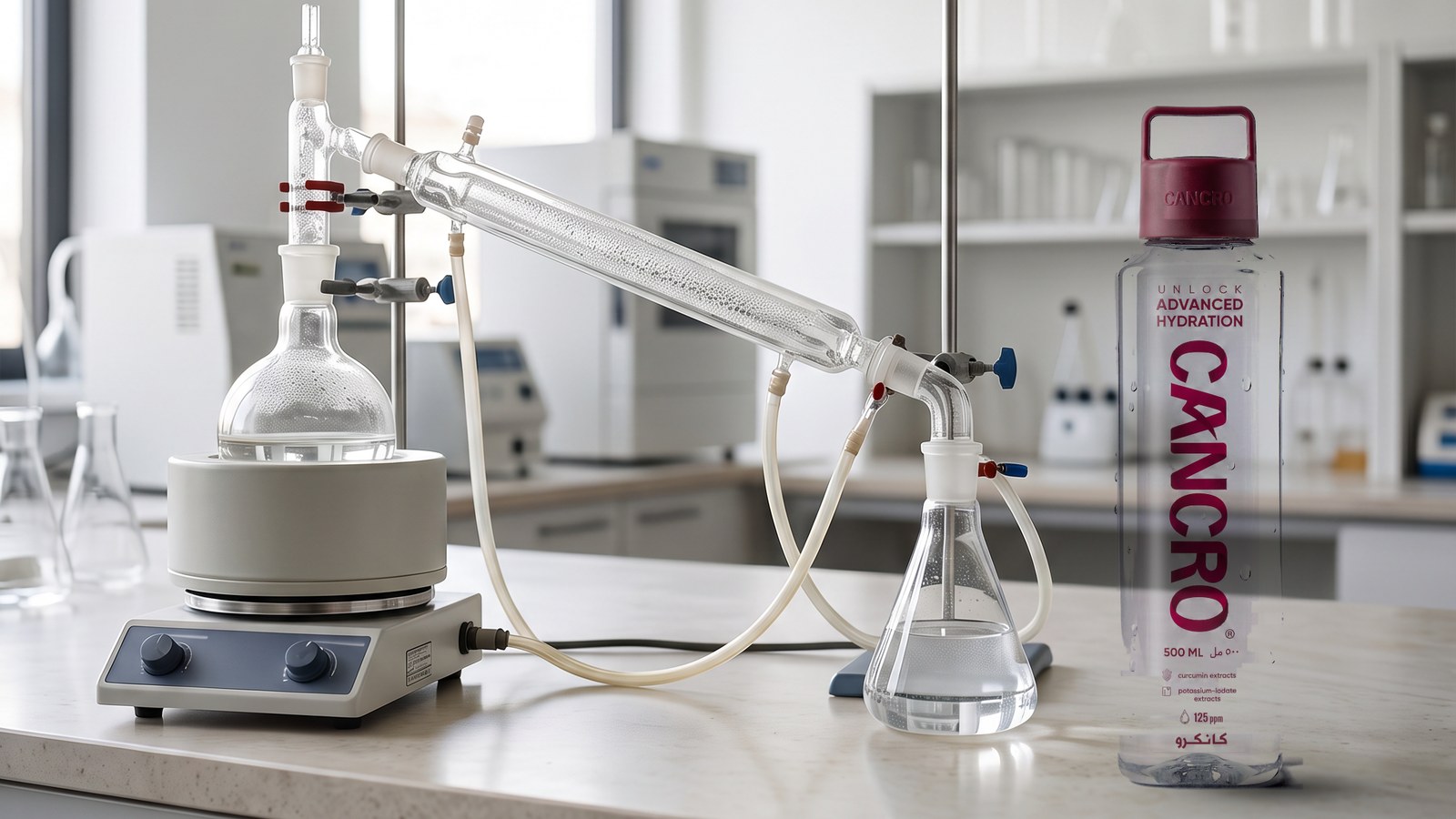
Deuterium-depleted water is made by separating water molecules by weight. The heavier molecules that carry deuterium evaporate very slightly more slowly than ordinary ones, so plants evaporate and re-condense water through many stages, usually under vacuum at low temperature, until the deuterium level falls to a set point such as 125 ppm. Electrolysis can also do it. Home RO filters, kettles and freezers cannot produce meaningful depletion.
Key takeaways
- A water molecule carrying deuterium (HDO) is chemically identical to ordinary water and only about 5% heavier, so filters cannot catch it.
- At room temperature the vapour above water carries about 8% less deuterium than the liquid; near boiling the gap shrinks to about 3%. That is why plants distil at low temperature, under vacuum.
- One evaporation step is not enough. Industrial columns repeat it many times to reach a stable, tested level.
- Reverse osmosis removes dissolved salts, not isotopes. Boiling and freezing at home shift deuterium by only a few ppm.
- A credible deuterium-depleted water states its ppm and tests every batch with isotope analysis.
Why deuterium is so hard to separate
In natural water, deuterium does not float around on its own. It sits inside water molecules, mostly as HDO, where one of the two hydrogen atoms is deuterium. An HDO molecule has the same shape, size and charge as ordinary H₂O and takes part in exactly the same chemistry. The only real difference is mass: HDO weighs about 19 atomic mass units against about 18 for H₂O. See heavy water vs deuterium-depleted water for the isotope itself.
Any separation process therefore has to work on weight alone. The physical handle is the vapour pressure isotope effect: lighter molecules escape into the vapour slightly more readily. Laboratory measurements put the size of that preference at about 8% at room temperature, falling to about 3% near 100 °C. Scale is the challenge. To move water from about 150 ppm to 125 ppm, a plant has to repeat a small enrichment step many times over, which is what makes the process energy-intensive and the water more expensive than ordinary bottled water.
The main production methods
| Method | How it works | Where it is used |
|---|---|---|
| Low-temperature vacuum distillation (fractional distillation) | Water is evaporated under reduced pressure and passed through a column with many separation stages; the lighter fraction is drawn off at the top. | The usual route for drinking-quality deuterium-depleted water |
| Electrolysis | Splitting water releases hydrogen depleted in deuterium; recombining it gives depleted water. | Smaller-scale and specialist production; energy-hungry |
| Chemical exchange | Deuterium moves between water and another hydrogen compound at different temperatures. | Mainly heavy-water production for industry |
Vacuum distillation, step by step
- Start with clean source water. Salts and impurities are removed first, so the column only has to separate isotopes.
- Evaporate at low pressure. Reducing the pressure lets water evaporate at a lower temperature, where the separation effect is stronger.
- Fractional separation. Vapour rises through a packed column and re-condenses again and again. Each pass shifts the light molecules upwards slightly; together, hundreds of these cycles gather the lighter water.
- Test before bottling. A sample from each batch is measured for deuterium by isotope analysis, and only water at the target level is bottled.
- Put minerals back. Distillation strips minerals along with everything else, so producers re-mineralise for taste. Cancro adds magnesium and potassium back.
Nothing is added to lower the deuterium; the heavier fraction is only taken out. Cancro follows this route to 125 ppm, under ISO 9001, GMP and HACCP. The science page shows the process in brief.
Can a reverse osmosis filter remove deuterium?
No. Reverse osmosis pushes water through a membrane with pores too small for dissolved salts, metals and many contaminants. HDO molecules are the same size and charge as ordinary water molecules, so they pass straight through with them. The same is true for carbon filters, jug filters and ion-exchange cartridges. That matters in the UAE, where many homes run RO units on desalinated tap water. These systems can make water cleaner-tasting, but they leave its deuterium level where it was.
Does boiling or distilling water at home remove deuterium?
Barely. At 100 °C the vapour above boiling water is only about 3% lighter in deuterium than the liquid. If you boil a kettle, the water left behind becomes very slightly heavier, not lighter. If you run a home water distiller and collect the condensed steam, you get water a few ppm lower at most, nowhere near a stated level such as 125 ppm. Distilled water is mainly water without minerals. It is not deuterium-depleted water.
Does freezing water reduce deuterium?
Only by a whisker. Ice takes up slightly more deuterium than the water around it, about 2% more at equilibrium. Freeze half a bottle, throw away the ice and keep the liquid, and the liquid ends up a couple of ppm lower than it started. It is a neat demonstration of isotope physics, not a practical way to make deuterium-depleted water. The shift is too small, and you cannot measure what you made.
How the ppm on a bottle is verified
Deuterium is measured with isotope-ratio mass spectrometry or laser absorption spectroscopy. Laboratories report it in ppm, or as a δ²H value in per mil (‰) against the ocean reference standard, VSMOW (about 155.7 ppm). When you compare brands, look for three things: a stated ppm, a statement that each batch is tested, and a producer willing to show a test result. Our ppm guide explains the numbers, how to read a water label covers the rest of the bottle, and where to buy deuterium-depleted water in the UAE covers prices and stockists.
Frequently asked questions
Is deuterium-depleted water the same as distilled water?
No. Distilled water has had its minerals removed, but its deuterium level stays close to the original water. Deuterium-depleted water has had part of its deuterium removed, usually to a stated level such as 125 ppm, and is often re-mineralised.
Can I make deuterium-depleted water at home?
Not in any meaningful or measurable way. Home RO, filters, boiling and freezing change deuterium by a few ppm at most, and you would need laboratory isotope analysis to know the result.
Why is deuterium-depleted water more expensive than regular bottled water?
Separating isotopes by weight takes many evaporation and condensation stages, which uses a lot of energy and equipment, and each batch has to be lab-tested.
Does deuterium-depleted water stay depleted after opening?
Yes. The isotope ratio is a property of the water itself and does not wear off like dissolved gases. Once opened, treat it like any bottled water and finish it within a day or two.
Why do some brands add minerals back?
Distillation strips dissolved minerals, which leaves water tasting flat. Adding minerals such as magnesium and potassium back gives a clean, balanced taste. Cancro has a TDS of 45 and a pH of 7.4.
Which method does Cancro use?
Vacuum distillation and fractional separation, with every batch lab-tested at 125 ppm before bottling, then magnesium and potassium added back.
Sources
- Horita J, Wesolowski DJ. Liquid-vapor fractionation of oxygen and hydrogen isotopes of water from the freezing to the critical temperature. Geochimica et Cosmochimica Acta, 1994.
- Kendall C, Caldwell EA. Fundamentals of isotope geochemistry. In: Isotope Tracers in Catchment Hydrology, Elsevier, 1998 (US Geological Survey).
- Lehmann M, Siegenthaler U. Equilibrium oxygen- and hydrogen-isotope fractionation between ice and water. Journal of Glaciology, 1991.
- Huang F, Meng C. Method for the production of deuterium-depleted potable water. Industrial & Engineering Chemistry Research, 2010.
- Commission on Isotopic Abundances and Atomic Weights (IUPAC). Isotopic compositions of hydrogen, including the VSMOW reference.
- Bowen GJ, Winter DA, Spero HJ, et al. Stable hydrogen and oxygen isotope ratios of bottled waters of the world. Rapid Communications in Mass Spectrometry, 2005.
Written by the Cancro team in Dubai and last reviewed on 8 October 2026. Sources are listed above and linked where they are openly available. Cancro is a drinking water, not a medicine, and is not intended to diagnose, treat, cure or prevent any disease. If you have a medical condition, ask your doctor before changing what you drink.