Heavy water vs deuterium-depleted water: same atom, opposite directions

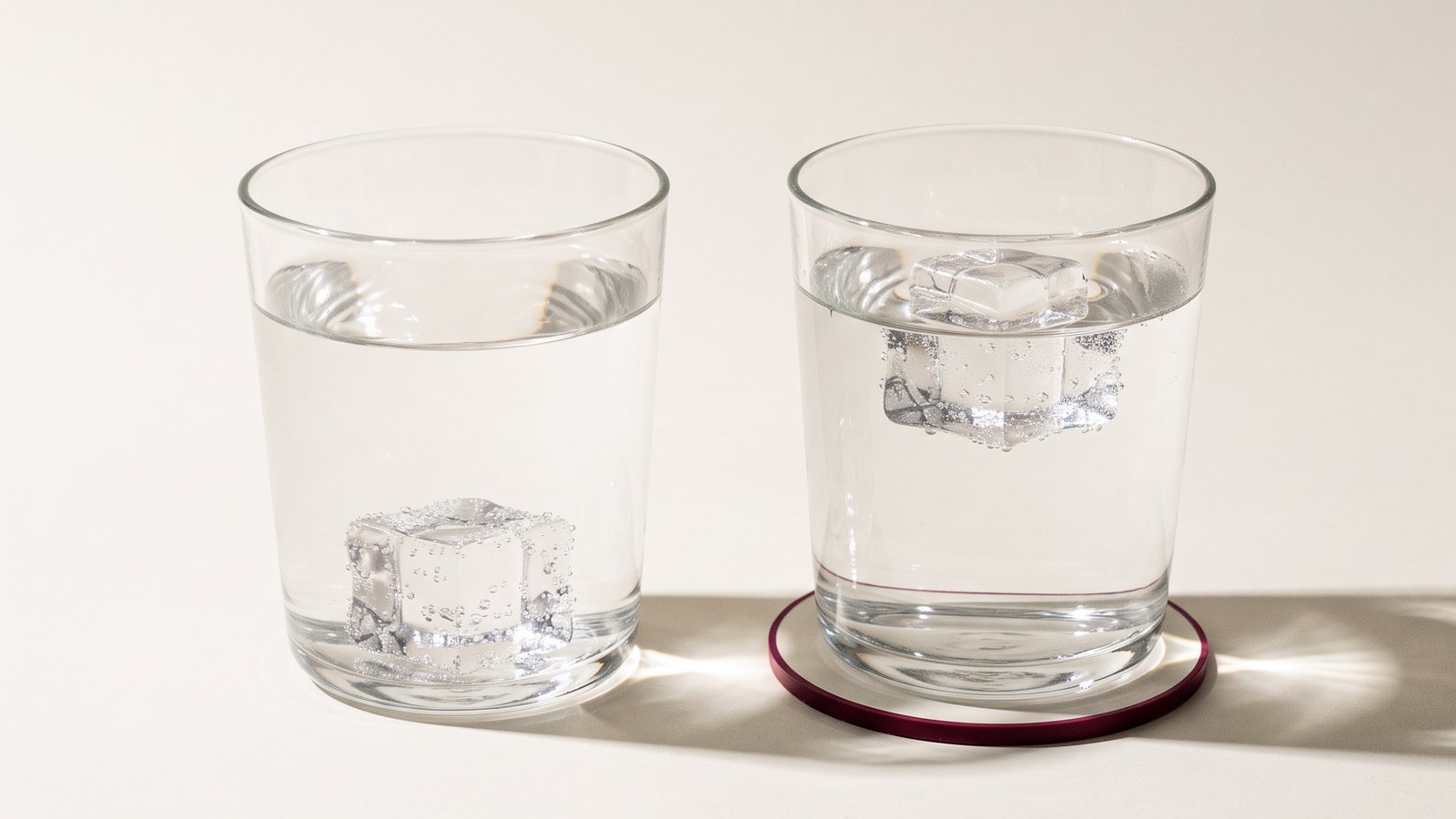
Heavy water and deuterium-depleted water sit at opposite ends of the same scale. Heavy water (D₂O) is water in which almost all the hydrogen is deuterium, the heavier, stable form of hydrogen. Deuterium-depleted water is ordinary drinking water with less deuterium than usual: around 125 ppm instead of roughly 150 ppm. One is an industrial material; the other is still just water to drink.
Key takeaways
- Deuterium is hydrogen with one extra neutron. It is stable and not radioactive; tritium is the radioactive form.
- Ordinary water carries about 150 ppm deuterium (the ocean reference standard is about 155.7 ppm), almost all of it as HDO, “semi-heavy” water.
- Heavy water is about 11% denser than ordinary water and freezes at 3.8 °C, and its ice sinks in a glass of normal water.
- Deuterium-depleted water such as Cancro at 125 ppm looks, tastes and behaves like ordinary water; only the isotope ratio is different.
- “Light water” in nuclear engineering means ordinary water, not deuterium-depleted water.
What deuterium is, in one paragraph
A normal hydrogen atom (protium) is one proton and one electron. Deuterium adds one neutron, so it weighs about twice as much (2.014 against 1.008 atomic mass units) while behaving the same way chemically. It is a stable isotope: it does not decay and gives off no radiation. The radioactive hydrogen isotope is tritium, which has two neutrons and is a different substance altogether. Deuterium occurs naturally in every drop of water on Earth, roughly one hydrogen atom in every 6,400. For the basics of the drink itself, see what deuterium-depleted water is.
Heavy, semi-heavy, ordinary and deuterium-depleted water compared
| Deuterium content | What it is | Where you meet it | |
|---|---|---|---|
| Heavy water (D₂O) | Almost all hydrogen atoms are deuterium | Both hydrogens in the molecule are deuterium | Nuclear reactors, laboratories, body-composition tests |
| Semi-heavy water (HDO) | One of two hydrogens is deuterium | The form deuterium takes in natural water | In every glass of water, about 1 molecule in 3,200 |
| Ocean reference water (VSMOW) | About 155.7 ppm | The international standard for “normal” water | Laboratory reference |
| Bottled waters worldwide | About 133 to 158 ppm | Natural spring, mineral and purified waters | Supermarket shelves; 234 brands measured |
| Deuterium-depleted water | Typically 25 to 125 ppm | Water with part of its deuterium removed | Cancro is bottled at 125 ppm |
The word “heavy” is literal. A molecule of heavy water weighs about 20 atomic mass units against 18 for ordinary water, and that is the root of every difference between them. Deuterium-depleted water moves the other way, but only slightly: removing a sixth of a trace isotope does not change how water looks, pours or tastes. Our guide to ppm levels explains how to read the number on a bottle.
How different is heavy water physically?
| Property | Ordinary water (H₂O) | Heavy water (D₂O) |
|---|---|---|
| Density at 25 °C | 0.997 g/mL | 1.1056 g/mL |
| Freezing point | 0 °C | 3.82 °C |
| Boiling point | 100 °C | 101.4 °C |
| Ice in a glass of ordinary water | Floats | Sinks |
That last row is the easiest way to see the difference: an ice cube made of heavy water is denser than liquid ordinary water, so it sinks straight to the bottom of the glass. Deuterium-depleted water shows nothing of the kind. At 125 ppm its density, freezing point and boiling point are indistinguishable from tap water without laboratory instruments.
Is heavy water dangerous to drink?
In small amounts, no. Your body already contains a few grams of deuterium, and researchers routinely give volunteers measured doses of heavy water to work out how much water is in the body. That is the “deuterium dilution” method published by the International Atomic Energy Agency. Effects in mammals appear only when deuterium makes up more than about 15% of body water, roughly a thousand times the natural level. That is far beyond anything you could reach by accident, and heavy water is not sold as a drink.
Deuterium-depleted water raises the opposite question: is less deuterium safe? It is still water, with the same molecules in slightly different proportions. We cover the evidence in is deuterium-depleted water safe?, and how your body’s own deuterium is set in our guide to deuterium in your body.
Why heavy water matters in nuclear reactors
Heavy water is valued because deuterium slows neutrons down without absorbing many of them. That makes it an efficient moderator, which is why some reactor designs use it and why it is produced on an industrial scale. Reactors that use ordinary water instead are called light-water reactors. In that industry, “light water” simply means normal water. When a drinks label says “light water”, it is borrowing the phrase loosely. The accurate term for the drink is deuterium-depleted water, with the ppm stated.
Where deuterium-depleted water sits on the scale
Natural waters already vary. Rain and snow from cold, high-latitude and high-altitude places carry less deuterium than water where evaporation is strong; natural waters span very roughly 80 to 175 ppm. The 234 bottled waters measured by Bowen and colleagues ranged from about 133 to 158 ppm. Deuterium-depleted drinking water is produced to a set level below that range. Values around 105 to 125 ppm are typical for everyday drinking, and very low values such as 25 ppm appear mainly in research and concentrates.
Cancro is bottled at 125 ppm, about a sixth less deuterium than ordinary water, and every batch is lab-tested before it is bottled. Magnesium and potassium go back in after the deuterium is reduced. Our guide to how deuterium-depleted water is made covers the process, and the science page sums up what is and is not known.
Frequently asked questions
Is deuterium radioactive?
No. Deuterium is a stable isotope of hydrogen and does not emit radiation. The radioactive hydrogen isotope is tritium.
Is deuterium-depleted water the same as “light water”?
Not exactly. In nuclear engineering, “light water” means ordinary water as opposed to heavy water. Deuterium-depleted water is ordinary water with part of its natural deuterium removed, usually to a stated level such as 125 ppm.
Can you taste the difference between heavy water and normal water?
A 2021 study found that people perceive pure heavy water as faintly sweet. Deuterium-depleted water tastes like ordinary still water, because its deuterium level is only slightly lower than normal.
How much deuterium is in normal water?
About 150 ppm, meaning roughly 150 deuterium atoms per million hydrogen atoms. The ocean reference standard is about 155.7 ppm, and bottled waters measured worldwide range from about 133 to 158 ppm.
Does heavy water ice really sink?
Yes. Ice made from heavy water is denser than liquid ordinary water, so it sinks in a glass of normal water, while an ordinary ice cube floats.
Is deuterium-depleted water heavy water?
No. It is the opposite: water with less deuterium than normal. Heavy water is almost pure deuterium oxide and is not sold as a drink.
Sources
- NIST. Atomic weights and isotopic compositions: hydrogen.
- Commission on Isotopic Abundances and Atomic Weights (IUPAC). Isotopic compositions of hydrogen, including the VSMOW reference.
- Heavy water: physical properties and uses (encyclopaedia summary with primary references).
- International Atomic Energy Agency. Introduction to body composition assessment using the deuterium dilution technique. IAEA Human Health Series No. 12, 2010.
- Bowen GJ, Winter DA, Spero HJ, et al. Stable hydrogen and oxygen isotope ratios of bottled waters of the world. Rapid Communications in Mass Spectrometry, 2005.
- Ben Abu N, Mason PE, Klein H, et al. Sweet taste of heavy water. Communications Biology, 2021.
Written by the Cancro team in Dubai and last reviewed on 4 October 2026. Sources are listed above and linked where they are openly available. Cancro is a drinking water, not a medicine, and is not intended to diagnose, treat, cure or prevent any disease. If you have a medical condition, ask your doctor before changing what you drink.