Alkaline vs hydrogen vs deuterium-depleted water: what is actually different for UAE buyers

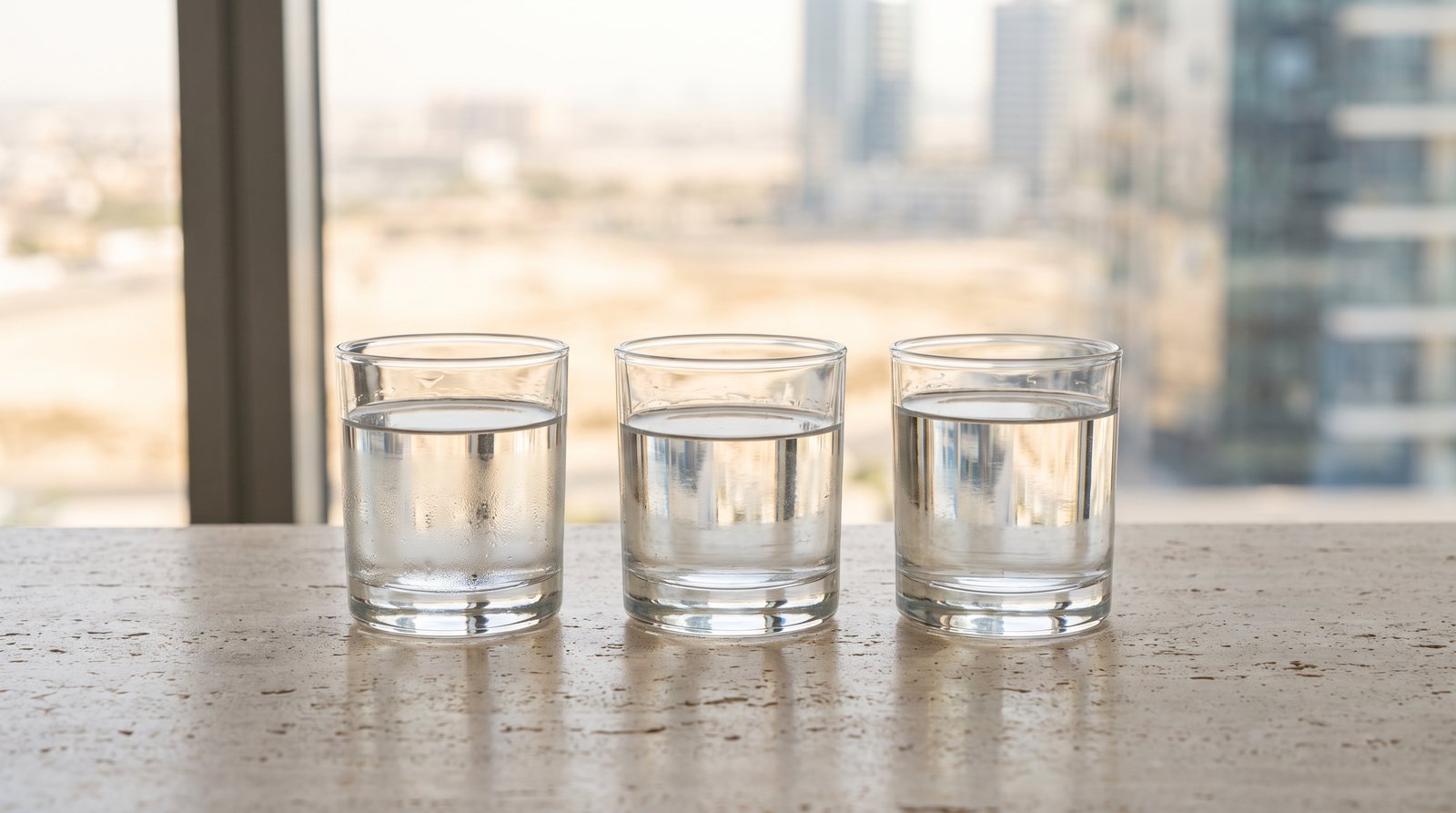
Alkaline water, hydrogen water and deuterium-depleted water are three different products that get sold with similar language. One changes the water’s pH, one dissolves a gas into it, and one removes a naturally occurring isotope. They differ in what they claim, how long the change lasts once you open the bottle, whether you can verify it, and what the evidence looks like. If you are standing in a Dubai supermarket or scrolling a delivery app trying to work out which premium water is worth the price over tap, this is the comparison you need.
The three at a glance
| Alkaline water | Hydrogen water | Deuterium-depleted water | |
|---|---|---|---|
| What is changed | pH raised to 8 to 9.5, usually by adding minerals or electrolysis | Molecular hydrogen gas (H₂) dissolved into the water | Heavy hydrogen isotope (deuterium) partly removed |
| Is anything added? | Usually yes (bicarbonate, calcium, magnesium) | Yes (H₂ gas) | No; something is taken out |
| Does the change survive opening the bottle? | Yes, but stomach acid neutralises it within minutes of drinking | No; H₂ escapes within hours, faster in a glass | Yes; isotope ratio is permanent |
| Can you verify the claim? | Yes, with a pH strip | Only with a dissolved-hydrogen meter at the moment of opening | Yes, by isotope-ratio mass spectrometry in a lab |
| Main claimed benefit | “Neutralises acidity”, better hydration | Antioxidant effect, recovery | Supports mitochondrial energy production |
| Human evidence | Weak; one small study on blood viscosity after exercise | Modest; several small trials with mixed results | Early; mostly cell and animal work |
| Typical UAE price per litre | AED 3 to 8 | AED 8 to 20 (cans) or a AED 500+ device | AED 12 to 17 |
Alkaline water: the pH does not reach your cells
Alkaline water is any water with a pH above 7, typically 8 to 9.5. It is made either by adding alkaline minerals such as bicarbonate or by passing water through an electrolysis unit. The marketing rests on the idea that modern diets are “acidic” and that alkaline water counteracts this.
The chemistry does not support that. Your stomach sits at a pH of around 1.5 to 3.5, and a glass of pH 9 water is neutralised almost immediately on arrival. Blood pH is held between 7.35 and 7.45 by the lungs and kidneys regardless of what you drink; if it moved with your beverage choices you would be in hospital. The one human study usually cited found a small difference in blood viscosity after exercise, in a group of 100 people, funded by a manufacturer. That is not nothing, but it is not a case for paying more.
Where alkaline water can legitimately help is mineral content. Desalinated UAE tap water is very low in calcium and magnesium, and a mineralised bottled water, alkaline or not, adds some back. That is a fair reason to choose it; the pH number is not.
Hydrogen water: real molecule, short shelf life
Hydrogen water has molecular hydrogen gas dissolved in it, typically at 0.5 to 1.6 milligrams per litre. Unlike the alkaline story, there is a plausible mechanism: molecular hydrogen acts as a selective antioxidant in laboratory settings, and there are a few dozen small human trials on exercise recovery, fatigue and metabolic markers. Results are mixed and the trials are small, but the field is active.
The practical problem is that hydrogen does not stay in water. It is the smallest molecule there is and escapes through plastic and out of any open container within hours, sometimes minutes once poured into a glass. That is why serious hydrogen water comes in aluminium cans or pouches with a “drink immediately” instruction, and why the AED 500 to 2,000 countertop generators exist. A bottle of hydrogen water that has been sitting on a shelf in a Deira supermarket for three months in summer heat may contain very little hydrogen by the time you open it, and you have no way to tell without a meter.
Deuterium-depleted water: permanent change, early evidence
Deuterium-depleted water takes the opposite approach to the other two. Nothing is added. Instead, some of the naturally occurring heavy hydrogen, deuterium, is removed. Ordinary water contains about 150 parts per million of deuterium; Cancro is produced at 125 ppm, and other brands range from around 105 down to 25 ppm. Because deuterium and ordinary hydrogen are chemically identical and differ only by mass, this cannot be done with a filter. It requires industrial isotope separation, which is why the product costs more than mineral water.
Two properties set it apart in a comparison like this. First, the change is permanent: 125 ppm water is still 125 ppm water a year after bottling, opened or not. Second, it is independently verifiable. Any isotope laboratory can measure the deuterium content of a sample by mass spectrometry and tell you whether the label is true. Neither of those things can be said of hydrogen water, and the second cannot be said of most wellness claims.
The evidence, however, is at an earlier stage than hydrogen water’s. The proposed mechanism is that deuterium’s extra mass slows the enzymes that produce cellular energy, and that lowering dietary deuterium eases that. Laboratory and animal work supports the idea. A 2024 scoping review in Metabolomics (Korchinsky et al.) identified 15 studies and concluded that randomised controlled trials in people are needed before cause and effect can be claimed. We would rather say that plainly than dress it up. You can read more in our guides to what deuterium-depleted water is and what the safety evidence shows.
And the baseline: UAE tap and standard bottled water
Any comparison of premium waters should be honest about the alternative. Municipal water in Dubai and Abu Dhabi is desalinated, chlorinated and tested to World Health Organization standards. It is safe to drink from the treatment plant; where problems arise it is usually in building tanks and pipes, which is why so many households use a filter or bottled water. Its main nutritional shortcoming is very low mineral content. Standard bottled mineral water fixes that for AED 1 to 3 per litre. For ordinary hydration in the heat, that is all most people need, and no premium water hydrates you “more” per litre than tap does.
How to choose
- You want minerals back in desalinated water. Any decent mineral water. Ignore the pH marketing.
- You are interested in the antioxidant research and can drink it fresh. Hydrogen water in cans, consumed immediately, or a generator if you will use it daily. Skip shelf-aged plastic bottles.
- You want a change that is permanent, verifiable and based on the mitochondrial rationale. Deuterium-depleted water, with the clear understanding that human evidence is early. Start with a small pack and judge it over a few weeks.
- You want to be told a bottle of water will fix a health problem. None of the three. See a doctor.
Questions to ask any premium water brand
- What exactly has been changed, and by how much, in numbers?
- Does the change survive shipping, shelf time and opening the bottle?
- Can the claim be tested by an independent lab, and will you show a certificate?
- Which human study supports the benefit you are describing, by name and year?
- Is there a UAE-registered company behind the product, with local delivery and support?
A brand that answers all five plainly is worth considering. One that answers with adjectives is not.
Cancro is a beverage, not a medicine. It is not intended to diagnose, treat, cure, or prevent any disease. Research referenced on this page describes deuterium-depleted water, hydrogen water and alkaline water in general and is not a claim about any specific product. Prices are indicative UAE retail ranges at the time of writing.
Related reading
- Deuterium ppm levels explained: what the number on the bottle actually means
- Deuterium-depleted water in the UAE: where to buy it and what it costs
- The science behind Cancro: how deuterium is removed
- How to read a bottled water label in the UAE: TDS, pH, sodium, magnesium, potassium and deuterium
- Heavy water vs deuterium-depleted water: same atom, opposite directions